IZUMI KATO
JANUARY 30 – JUNE, 2026
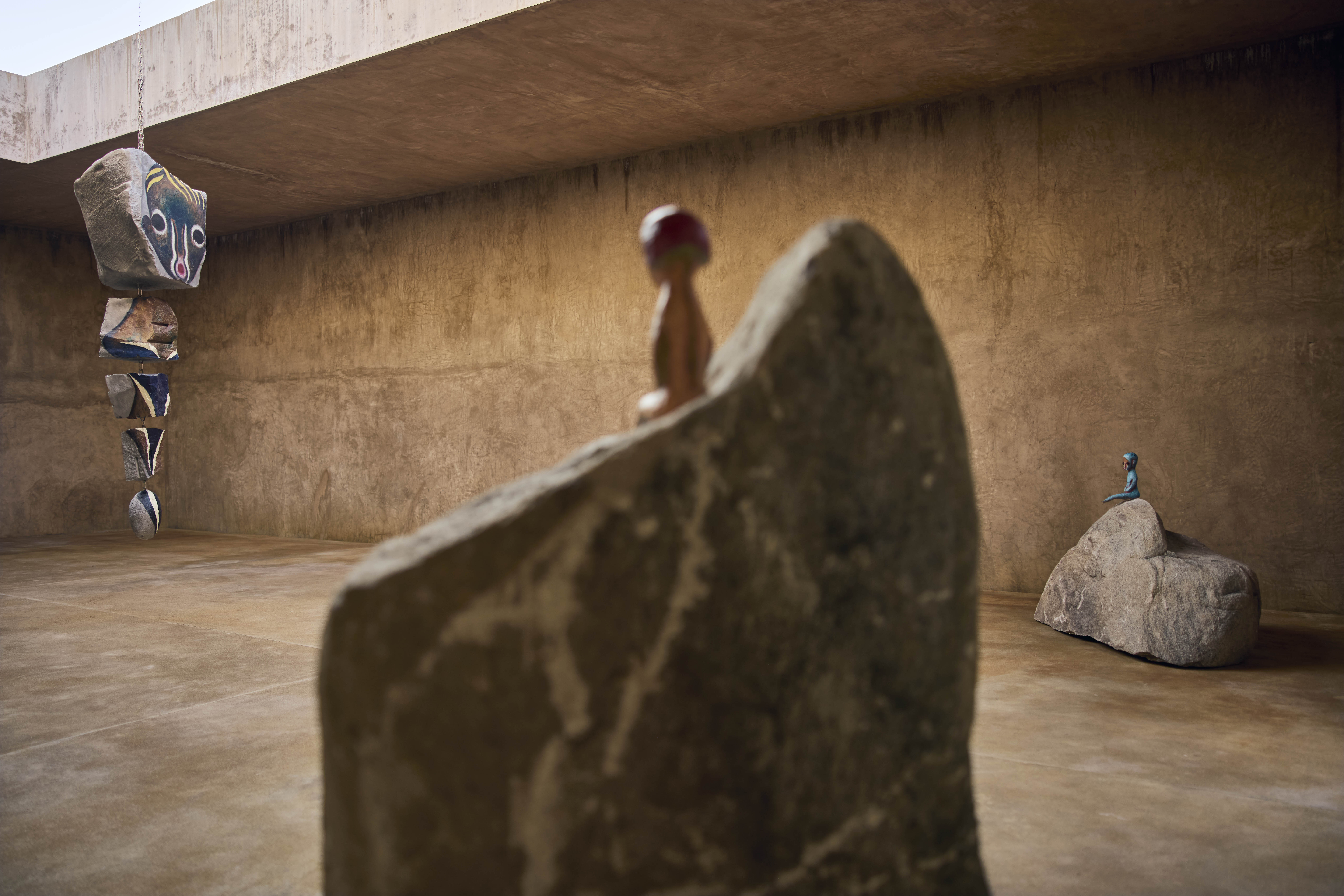
At Meridiano, Izumi Kato presents a new group of painted sculptures that expand upon the artist’s ongoing exploration of the natural world and the human experience. Kato approaches sculpture, painting,
and installation not as fixed categories but as interrelated modes of inquiry. Each work is presented in direct dialogue with its surroundings, activating the unique architecture of Meridiano’s open-air spaces.
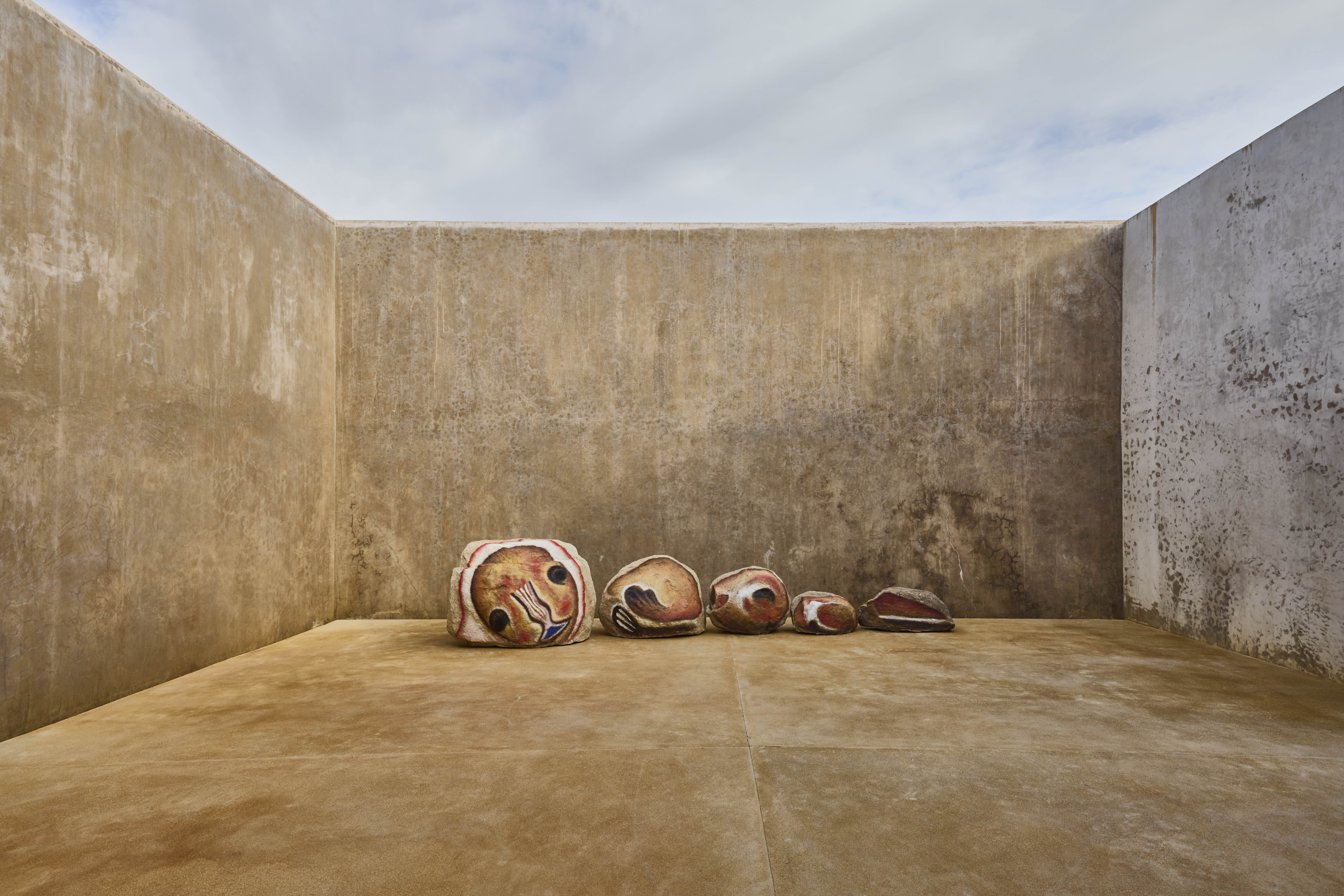

Kato’s artistic language is grounded in the act of making and the articulation of the dynamic interplay of material, process, and image. Forms are reduced to their essentials, surfaces are painted by hand, and underlying structures are often revealed rather than concealed. Throughout his practice, canvases find
new ways to extend beyond the single rectangle, supports are made visible, and stitches are left
exposed. These gestures play upon conventions of display, allowing structure and intuitive expression to exist in constant conversation.
The four new works exhibited at Meridiano have developed out of the artist’s numerous visits to the coast
of Oaxaca. For Kato this area has been a place of exploration, friendship, respite, and inspiration. Its location along a narrow strip of desert between the mountains and the sea resonates with the elemental
power of his art.
Throughout the exhibition, Kato employs the geometry of Meridiano in innovative ways. Both vertical and horizontal axes are brought into tension, and works are positioned to engage light, shadow, and movement over time. Rather than occupying space passively, the works reorient the experience of the architecture. The viewer encounters Kato’s sculptures in succession and is compelled to look closely, to navigate the space attentively, and to register subtle shifts in perception.
Throughout the exhibition, Kato employs the geometry of Meridiano in innovative ways. Both vertical and horizontal axes are brought into tension, and works are positioned to engage light, shadow, and movement over time. Rather than occupying space passively, the works reorient the experience of the architecture. The viewer encounters Kato’s sculptures in succession and is compelled to look closely, to navigate the space attentively, and to register subtle shifts in perception.
One approaches the space from a turning path through a garden of cacti
and native flora, and the visitor first enters into a square courtyard
fully open to the sky. A monumental stone sculpture awaits the viewer,
reclined before the east wall of the space. This powerful hitogata, one
of Kato’s signature humanoid figures, is comprised of a constellation of
massive boulders, hand-painted by the artist in situ. Selected from the
nearby mountains, each stone is chosen and placed with a thoughtfulness
that recalls the principle of ishi-no-kowan-ni-shitagau—to follow the
request of the stone. Its horizontality relates the recumbent figure to
the earth and evokes stability and geologic time.
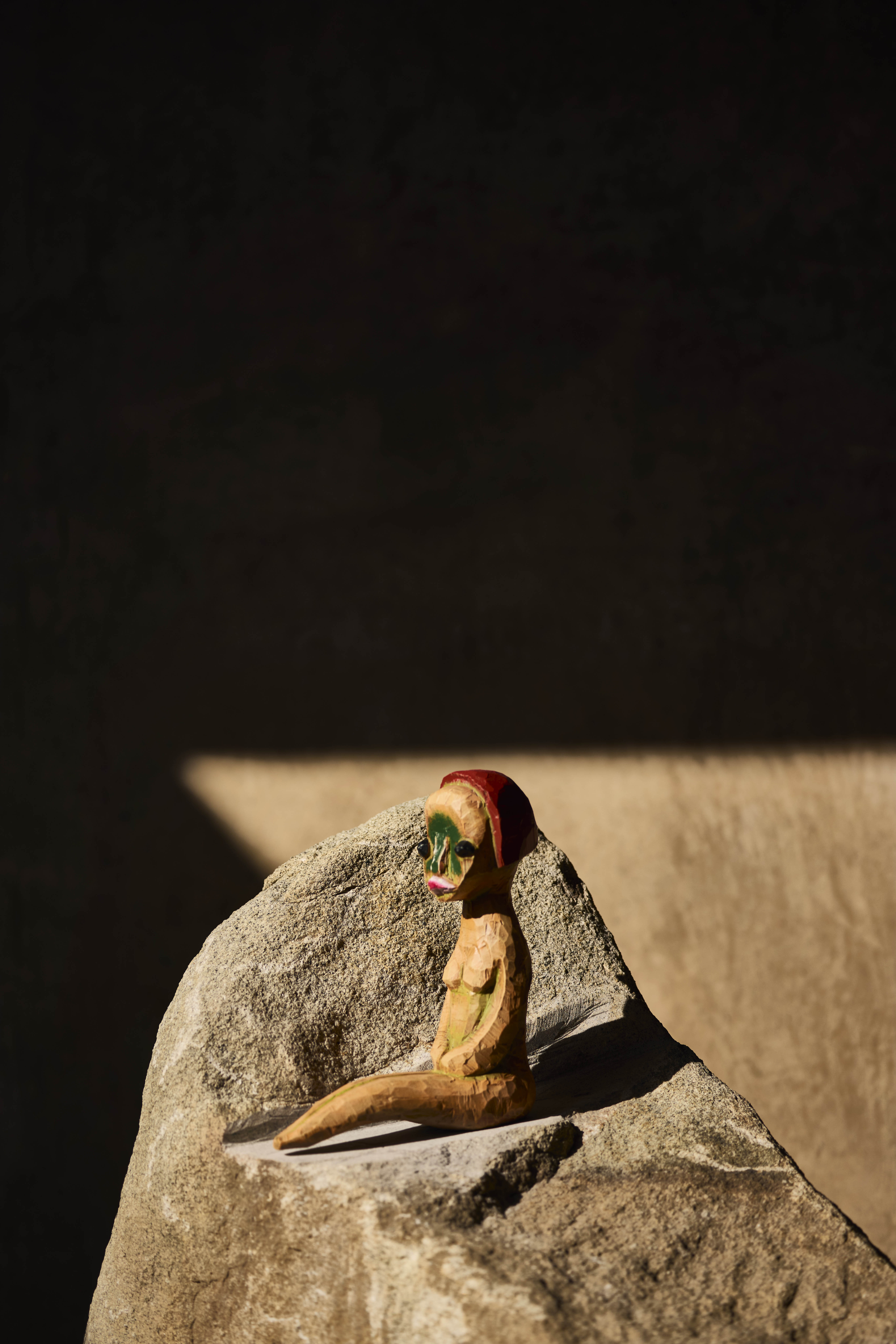
From this square courtyard the viewer turns south towards the sound of the ocean, and enters a rectangular room proportioned according to sacred geometry, partially enclosed with a central oculus running north/ south, open to the sun and stars. Centered in the space hovers a five element hitogata sculpture in painted aluminum, suspended from above the open oculus. Neither grounded or ascendant, it occupies a quiet, liminal space between the earth and the sky. The vertical orientation evokes celestial forces, and as the sun moves from east to west, the light moves across the space and shadows shift across the sculpture, transforming the installation into an immersive measure of time. To be discovered to the left and right of the entrance to this room are two small-scale painted bronze figures, seated and watchful, reinforcing a mood of contemplation and stillness. Each rests upon a large local stone, again searched for and selected by the artist, evocative of mountains or islands and recalling the yorishiro from the Shinto traditions of Kato’s native Shimane prefecture.
Kato’s work resists fixed meanings. He invites openness and interpretation, allowing the sculptures to have a new conversation with each viewer. At Meridiano, the interaction between material, form, and space creates an environment of focused attention—one that encourages reflection, slowness, and ongoing dialogue.
From this square courtyard the viewer turns south towards the sound of the ocean, and enters a rectangular room proportioned according to sacred geometry, partially enclosed with a central oculus running north/ south, open to the sun and stars. Centered in the space hovers a five element hitogata sculpture in painted aluminum, suspended from above the open oculus. Neither grounded or ascendant, it occupies a quiet, liminal space between the earth and the sky. The vertical orientation evokes celestial forces, and as the sun moves from east to west, the light moves across the space and shadows shift across the sculpture, transforming the installation into an immersive measure of time. To be discovered to the left and right of the entrance to this room are two small-scale painted bronze figures, seated and watchful, reinforcing a mood of contemplation and stillness. Each rests upon a large local stone, again searched for and selected by the artist, evocative of mountains or islands and recalling the yorishiro from the Shinto traditions of Kato’s native Shimane prefecture.
Kato’s work resists fixed meanings. He invites openness and interpretation, allowing the sculptures to have a new conversation with each viewer. At Meridiano, the interaction between material, form, and space creates an environment of focused attention—one that encourages reflection, slowness, and ongoing dialogue.
ABOUT THE ARTIST
Izumi Kato was born in 1969 in Yasugi, a rural city in Shimane Prefecture surrounded by nature. After high school, he entered the Department of Painting at Musashino Art University. Alongside painting, he spent a significant amount of time playing music in a band. After graduation, while working and continuing to paint, he began pursuing life as an artist.
Around the age of thirty, Kato began focusing on the human form as a central motif, titling nearly all his works Untitled. His figures are unclothed and appear without any background or objects that would imply a particular context. What Kato sought was not to tell stories or convey emotion through his figures but to explore how to construct a painting using hitogata—the human-like forms that would become central to his work. Embodying a primal, universal form of humanity founded less on reason than on intuition, these magical beings invite viewers to recognize themselves. A turning point came around 2003, when, still feeling his way forward, Kato began working with wood. He recalls that the act of creating sculptural works in three dimensions helped him reconsider the relationship between human f igures and the two-dimensional worlds they inhabit on canvas.
In 2007, Kato’s invitation to the 52nd Venice Biennale marked his emergence as an internationally recognized artist. Through exhibitions held in Japan and across the world, Kato has garnered esteemed attention as an innovative artist. At the present day, Kato lives and works between Tokyo, Japan, and Hong Kong, China.
Izumi Kato was born in 1969 in Yasugi, a rural city in Shimane Prefecture surrounded by nature. After high school, he entered the Department of Painting at Musashino Art University. Alongside painting, he spent a significant amount of time playing music in a band. After graduation, while working and continuing to paint, he began pursuing life as an artist.
Around the age of thirty, Kato began focusing on the human form as a central motif, titling nearly all his works Untitled. His figures are unclothed and appear without any background or objects that would imply a particular context. What Kato sought was not to tell stories or convey emotion through his figures but to explore how to construct a painting using hitogata—the human-like forms that would become central to his work. Embodying a primal, universal form of humanity founded less on reason than on intuition, these magical beings invite viewers to recognize themselves. A turning point came around 2003, when, still feeling his way forward, Kato began working with wood. He recalls that the act of creating sculptural works in three dimensions helped him reconsider the relationship between human f igures and the two-dimensional worlds they inhabit on canvas.
In 2007, Kato’s invitation to the 52nd Venice Biennale marked his emergence as an internationally recognized artist. Through exhibitions held in Japan and across the world, Kato has garnered esteemed attention as an innovative artist. At the present day, Kato lives and works between Tokyo, Japan, and Hong Kong, China.

Meridiano is situated on the Oaxacan coast in Puerto Escondido, Mexico, offering an open framework for long-form, site-specific, and experimental exhibitions of artwork by artists working internationally and across disciplines. Founded by Nicholas Olney and Boris Vervoordt on the principles of dialogue and exchange, Meridiano’s contemporary art programming will be realized over an exhibition per year.